


Introduction to Scalable Software
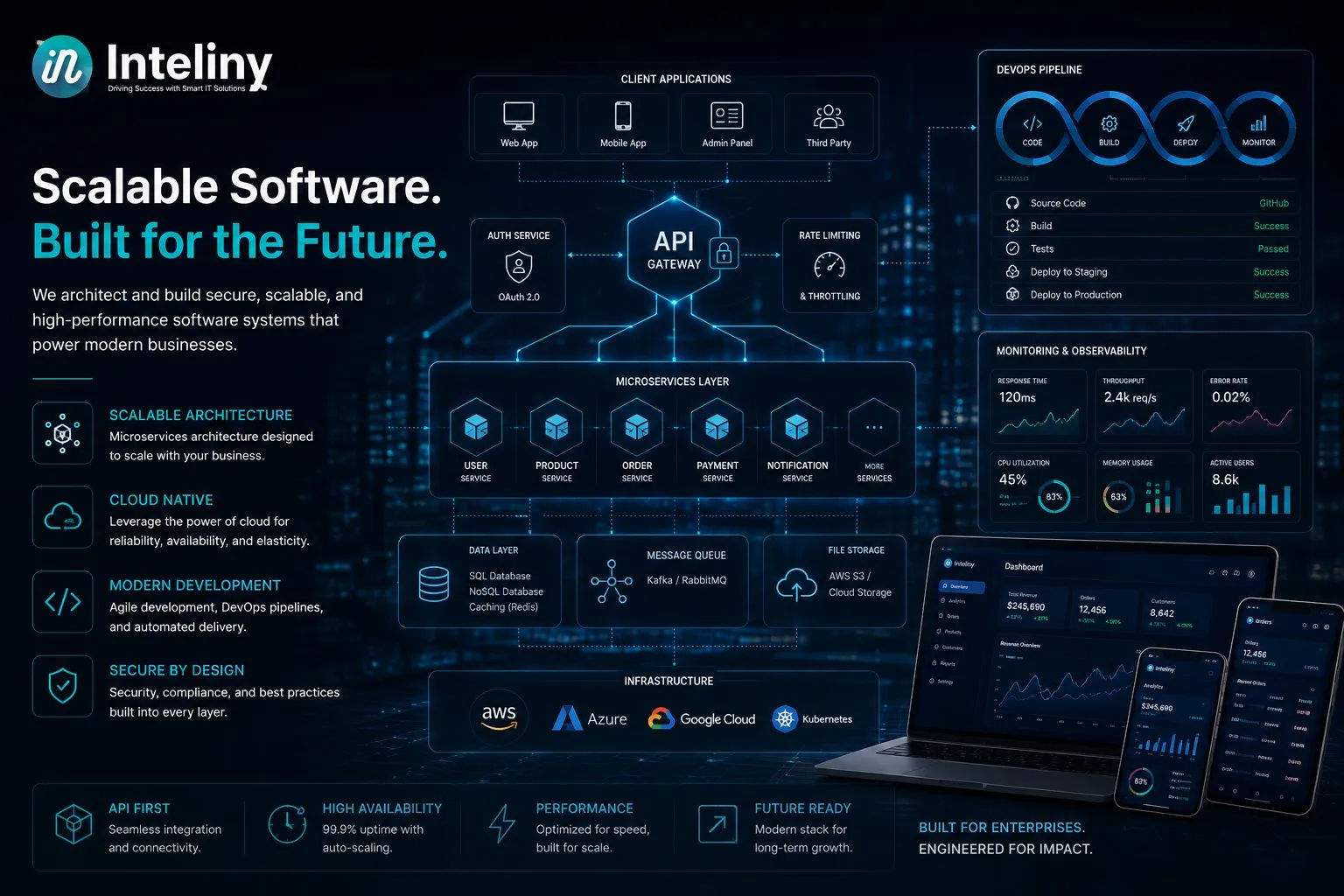
Building scalable software is crucial for startups to ensure their applications can handle increased traffic and user growth without compromising performance. Scalable software architecture is designed to scale horizontally or vertically to meet the growing demands of an application. In this blog post, we will cover the best practices for building scalable software, including APIs, microservices vs monolith, database planning, DevOps, CI/CD, cloud-native development, performance optimization, monitoring, and future-proof architecture.
Scalable Software Architecture
Monolithic Architecture
A monolithic architecture is a traditional approach where all components of an application are built into a single, self-contained unit. While this approach is simple and easy to develop, it can become cumbersome and difficult to scale as the application grows.
Microservices Architecture
A microservices architecture, on the other hand, is a modular approach where an application is broken down into smaller, independent services that communicate with each other through APIs. This approach allows for greater flexibility, scalability, and fault tolerance.
APIs and Microservices
API Design
Well-designed APIs are essential for building scalable software. APIs should be simple, intuitive, and follow standard protocols such as REST or GraphQL. APIs should also be designed with security and authentication in mind to ensure that sensitive data is protected.
Microservices Communication
Microservices communicate with each other through APIs, which can be synchronous or asynchronous. Synchronous communication involves direct requests and responses between services, while asynchronous communication involves messaging queues or event-driven architecture.
Database Planning
Database Types
There are several types of databases, including relational databases, NoSQL databases, and graph databases. Relational databases are suitable for structured data, while NoSQL databases are suitable for unstructured or semi-structured data. Graph databases are suitable for complex relationships between data entities.
Database Scaling
Databases can be scaled vertically or horizontally. Vertical scaling involves increasing the power of a single database server, while horizontal scaling involves adding more database servers to distribute the load.
DevOps and CI/CD
DevOps Culture
DevOps is a culture that emphasizes collaboration and communication between development and operations teams. DevOps aims to improve the speed and quality of software releases by automating testing, deployment, and monitoring.
CI/CD Pipelines
CI/CD pipelines are automated workflows that build, test, and deploy software applications. CI/CD pipelines can be triggered by code changes, scheduled events, or manual interventions.
Cloud-Native Development
Cloud-Native Architecture
Cloud-native architecture is designed to take advantage of cloud computing services such as scalability, on-demand resources, and managed services. Cloud-native applications are built using cloud-native technologies such as containers, serverless computing, and cloud-based databases.
Cloud-Native Benefits
Cloud-native development offers several benefits, including reduced costs, increased agility, and improved scalability. Cloud-native applications can be deployed quickly and easily, and can scale up or down to meet changing demands.
Performance Optimization
Performance Metrics
Performance metrics such as response time, throughput, and latency are essential for measuring the performance of a software application. Performance metrics can be collected using monitoring tools such as New Relic, Datadog, or Prometheus.
Performance Optimization Techniques
Performance optimization techniques such as caching, content delivery networks (CDNs), and load balancing can improve the performance of a software application. Performance optimization techniques can be applied at the code level, infrastructure level, or network level.
Monitoring and Logging
Monitoring Tools
Monitoring tools such as Nagios, Splunk, or ELK Stack can collect metrics and logs from a software application. Monitoring tools can alert teams to performance issues, errors, or security breaches.
Logging Best Practices
Logging best practices such as logging levels, log rotation, and log retention can help teams troubleshoot issues and improve the performance of a software application.
Future-Proof Architecture
Architecture Principles
Architecture principles such as separation of concerns, loose coupling, and high cohesion can help teams build future-proof software applications. Architecture principles can guide the design and development of software applications.
Emerging Trends
Emerging trends such as artificial intelligence, machine learning, and Internet of Things (IoT) can impact the design and development of software applications. Teams should stay up-to-date with emerging trends and technologies to build future-proof software applications.
Common Questions
What is Scalable Software?
Scalable software is designed to scale horizontally or vertically to meet the growing demands of an application.
What is Microservices Architecture?
Microservices architecture is a modular approach where an application is broken down into smaller, independent services that communicate with each other through APIs.
What is Cloud-Native Development?
Cloud-native development is designed to take advantage of cloud computing services such as scalability, on-demand resources, and managed services.
Key Takeaways
In conclusion, building scalable software requires a deep understanding of software architecture, APIs, microservices, database planning, DevOps, CI/CD, cloud-native development, performance optimization, monitoring, and future-proof architecture. By following best practices and staying up-to-date with emerging trends and technologies, teams can build scalable software applications that meet the growing demands of users.